.png)
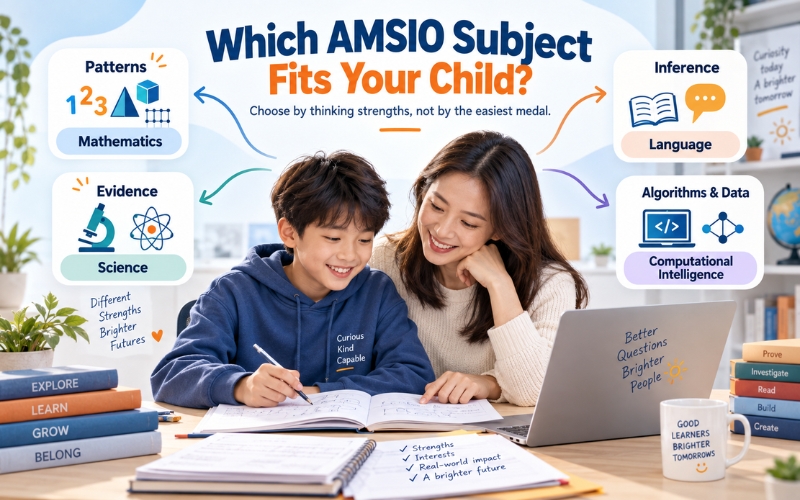
How Should Parents Choose an AMSIO Subject? School grades can be useful, but they should not be the only factor when choosing an AMSIO subject. A student may achieve high marks in Mathematics because they practise regularly, but feel much more curious when learning Science. Another student may have strong English results but enjoy interpreting stories and ideas more than memorizing vocabulary or grammar rules. That is why parents should look beyond “Which subject is my child best at?” and pay attention to how the child reacts when facing a new problem. A simple way to think about subject fit is: If your child often enjoys... Subject to explore Finding patterns and logical relationships Mathematics Asking why something happens and looking for evidence Science Understanding meaning and making inferences Language Breaking problems into steps and working with algorithms or data Computational Intelligence
This is not an official placement test. It is simply a practical way for parents to narrow down the options before making a final choice.
Mathematics: A Good Fit for Students Who Notice Patterns Mathematics may suit students who enjoy looking for relationships between numbers, shapes, sequences, and different pieces of information. AMSIO Mathematics covers areas such as number theory, algebra, geometry, probability, and mathematical reasoning. So the subject is not only about calculation speed or remembering formulas. Students also need to recognize patterns, connect information, and work out why a solution makes sense. You may already notice this type of thinking at home. A child might see a number sequence and immediately try to work out what comes next. They may enjoy logic puzzles, compare different ways of solving the same problem, or keep testing an idea until they understand the rule behind it.
Science: A Good Fit for Students Who Keep Asking “Why?” Some children are naturally curious about how the world works. They may ask why the sky changes color, why some objects float, why plants grow differently, or what causes one result instead of another. That curiosity can be a useful sign when considering Science. AMSIO Science includes Physics, Chemistry, Biology, and Earth Sciences, covering both theory and applied concepts. Students therefore need more than factual knowledge. They also need to observe, compare information, and connect evidence with an explanation. For example, if two plants grow at different speeds, one student may simply notice which plant is taller. Another may start wondering whether the difference came from sunlight, water, soil, or temperature. That second response shows a useful scientific habit: looking for evidence before reaching a conclusion. A child who enjoys experiments, cause-and-effect questions, real-world phenomena, or investigating why something happened may feel comfortable with Science. They do not need to know advanced scientific concepts from the beginning. Being curious enough to keep asking questions is already a good place to start.
Language: A Good Fit for Students Who Read Beyond the Words Language is not only for students who are good at vocabulary or grammar. AMSIO Language includes Reading, Vocabulary, Grammar, Critical Reading, and Inference. For older students, Critical Reading becomes a more important part of the assessment. That makes inference an important clue when thinking about subject fit. Imagine a story says that a character enters a classroom, notices an empty chair, and quietly puts away a birthday card. The writer may never explain exactly what happened. Some students will naturally begin connecting the clues. Who was the card for? Why is the chair empty? How might the character be feeling? That ability to understand what is suggested, rather than only what is directly written, is an important part of reading deeply. Students who enjoy interpreting stories, understanding tone, comparing viewpoints, or discovering meaning from context may be well suited to Language.
Computational Intelligence: A Good Fit for Students Who Think Step by Step Computational Intelligence is sometimes mistaken for a subject only for students who already know programming. But coding is only part of the picture. AMSIO Computational Intelligence covers algorithmic thinking, computer science, AI, programming, data science, and no-code/low-code development. A more useful way to think about subject fit is to look at how a student organizes a problem. Suppose you ask a child to explain how a robot should make a sandwich. A person may understand the instruction “Make a sandwich,” but a robot would need much clearer steps: take the bread, add the filling, place the second slice on top, and complete the task in the correct order. That is a simple example of algorithmic thinking. The same applies to data. Some students enjoy looking at charts, tables, or sets of numbers and trying to understand what they show. They may like finding trends, comparing information, or deciding which data is useful. These habits can be a good match for Computational Intelligence because the subject brings together logic, algorithms, problem-solving, technology, and data. The assessment also changes with level. Level 1 focuses on multiple-choice questions and logical reasoning, while Levels 2 and 3 include a Coding/Logic Task alongside the theory section. So students do not need to start as experienced coders. What matters more is whether they enjoy solving problems in a structured, step-by-step way.
What If Your Child Seems to Fit More Than One Subject? This is common. A student who enjoys patterns may be interested in both Mathematics and Computational Intelligence. A child who enjoys reading but also asks many questions about the natural world may feel drawn to both Language and Science. AMSIO allows students to register for one or more subjects. That means parents do not always have to force a choice too early. If several subjects seem suitable, consider three things together: interest, thinking style, and readiness. Which type of problem holds your child’s attention for longer? Which subject makes them want to try again after getting an answer wrong? Which challenge feels difficult, but still makes them curious? Those reactions often say more about subject fit than school marks alone.
Conclusion When choosing an AMSIO subject, there is no need to begin by asking which one is easiest or which one offers the best chance of winning. Start by watching how your child thinks. If they naturally look for patterns and logical relationships, Mathematics may be worth exploring. If they often ask “why” and want evidence before accepting an explanation, Science may be a good fit. If they enjoy interpreting meaning and making inferences, Language could suit them. And if they like breaking problems into steps and working with algorithms or data, Computational Intelligence may be the right direction. There is no single best AMSIO subject for every student. The better choice is the one that matches the student’s way of thinking, keeps them curious, and gives them room to grow.