.png)
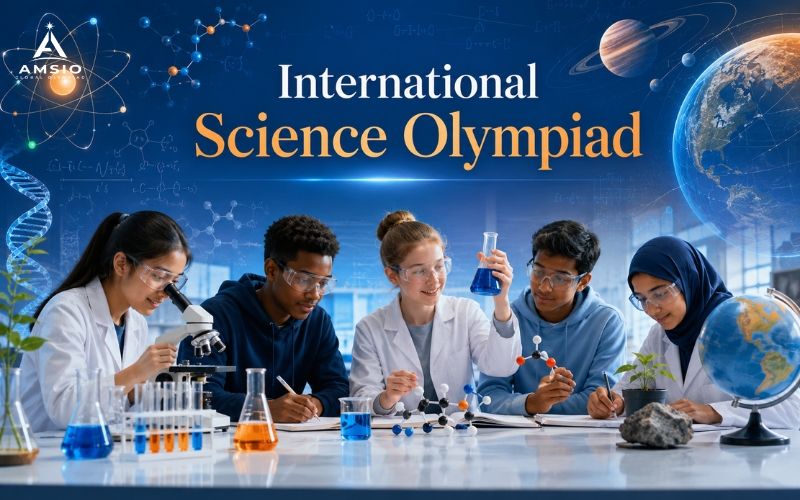
Science in AMSIO Is More Than a Test of Memorization One of the most common questions about AMSIO is how the program differs from conventional academic competitions. In the 2026–2027 Handbook, AMSIO clearly emphasizes the assessment of critical thinking rather than memorization. This is particularly meaningful in Science. Studying science is not simply about memorizing physics formulas, learning the names of organs in the human body, or understanding a chemical reaction. Knowledge truly becomes a skill when students can use it to explain a phenomenon, identify relationships between different factors, or determine how to respond to an unfamiliar situation. Within the AMSIO framework, Science includes both theory and applied concepts at each level. This means that the competition is not limited to asking students what they know; it also considers what they can do with the knowledge they have acquired. This approach is consistent with AMSIO’s competency-based philosophy, in which Problem-Solving, Creativity, Knowledge Application, and Critical Thinking are among the six core competencies the program aims to develop.
What Does the AMSIO International Science Competition Cover? The Science competition at AMSIO is designed for students from Grades 1 to 12. It is organized into six grade bands and focuses on four major scientific fields:
Physics Physics helps students explore the laws that govern the physical world, including motion, forces, energy, and other physical phenomena appropriate to each grade band. The value of Physics lies in more than simply using formulas. When approaching a physics problem, students often need to identify the relevant data, recognize relationships between quantities, select appropriate knowledge, and reason their way toward a solution. This provides an excellent foundation for developing logical thinking and systematic problem-solving skills.
Chemistry Chemistry focuses on matter in terms of its composition, properties, and transformations. As students progress to higher levels, studying Chemistry involves more than memorizing concepts. They need to connect information, identify patterns, and apply their knowledge in different contexts. This process makes Knowledge Application—the ability to transfer theoretical knowledge to practical contexts—increasingly important.
Biology Biology introduces students to the world of living things, from concepts related to their immediate surroundings at lower levels to more complex biological systems as they advance. A biology problem may require students to connect multiple pieces of information rather than simply recall an isolated definition. This encourages them to observe, compare, classify, and draw conclusions based on evidence.
Earth Sciences Earth Sciences broaden students’ scientific perspectives to include the environment, the Earth, and natural phenomena. This area helps students view science as an interconnected system involving multiple factors. Instead of studying isolated facts, students are encouraged to understand the relationships between the causes, processes, and outcomes of a phenomenon. Together, Physics, Chemistry, Biology, and Earth Sciences form the Science component of AMSIO for students in Grades 1–12.
Six Science Grade Bands from Grades 1 to 12 One notable feature of the AMSIO International Science Competition is that the Science test does not use a single structure for all students from Grades 1 to 12. Instead, the program divides participants into six grade-band levels: Grades 1–2 Grades 3–4 Grades 5–6 Grades 7–8 Grades 9–10 Grades 11–12 According to the examination structure published in the Handbook, each Science test consists of 25 questions, with a time limit of 60 minutes, using a multiple-choice and short-answer format. Organizing students into two-grade bands allows the assessment content to be better aligned with the learning level of each stage. Clearly, a student in the early years of primary school should not be expected to approach science with the same level of abstraction as a student in the final years of secondary school. At the lower grade levels, the focus may begin with recognizing and understanding scientific phenomena appropriate to students’ developmental stages. As students move into higher grade bands, the amount of knowledge and the connections between concepts become increasingly complex, creating opportunities for them to develop deeper reasoning and application skills. AMSIO also allows students to register for a competition level higher than their current grade, a format referred to in the Handbook as grade skipping. This may be a suitable option for students who wish to take on a greater academic challenge.
How Is Scientific Thinking Developed? Scientific thinking does not emerge simply from learning a large amount of knowledge. It develops when students regularly ask questions, seek evidence, identify relationships, and evaluate whether the knowledge they possess can genuinely explain a problem.
-
Observing and Identifying Information Before explaining a phenomenon, students need to recognize what is happening. In science, observation is not merely about “seeing.” It also involves determining which information is important, which factors may influence the outcome, and which data need to be connected to previously acquired knowledge. This is the first foundation of scientific thinking.
-
Analyzing Evidence and Identifying Relationships After receiving information, learners must know how to process it. Are two pieces of evidence related? What is the cause, and what is the effect? Is there a pattern emerging? Which information supports or contradicts a claim? This analytical ability helps students move from simply “knowing facts” to using evidence to draw conclusions. AMSIO defines Critical Thinking as the ability to analyze problems logically, evaluate evidence, and reason through complex challenges. This competency is closely connected to the way scientific thinking works.
-
Applying Knowledge in New Contexts A student may memorize a principle but still feel uncertain when faced with a situation that differs from the examples in a textbook. The gap between these two situations is precisely where Knowledge Application becomes important. AMSIO describes Knowledge Application as the ability to transfer theoretical understanding to practical contexts across different subjects and situations. In Science, this is a particularly important competency. Students need not only to understand a concept in Physics, Chemistry, or Biology, but also to recognize when that knowledge can be used to explain or address a problem.
-
Solving Unfamiliar Problems Science becomes more engaging when a question does not exactly resemble a familiar example. When faced with a new problem, students need to choose a strategy, try to connect different areas of knowledge, and sometimes adjust their approach if their initial line of reasoning is not suitable. This reflects the spirit of Problem-Solving as defined by AMSIO: approaching unfamiliar challenges with persistence, strategic thinking, and the ability to apply knowledge creatively.
Knowledge Application In traditional learning environments, students may become accustomed to the following cycle: learn a concept, memorize a formula, and solve a similar type of exercise. However, in real life, a problem rarely comes with a reminder saying, “Use Formula A.” Learners must determine for themselves which knowledge is relevant. That is why Knowledge Application is so important in Science. When students can connect knowledge from multiple topics to a new context, they gradually move from simply “learning science” to thinking scientifically.
Creativity Creativity is often associated with the arts, but it also plays an important role in science. A problem may have several possible approaches. A piece of evidence may lead to multiple hypotheses. An unfamiliar situation may require students to combine knowledge in a way they have never attempted before. Among AMSIO’s six core competencies, Creativity is defined as the ability to generate original ideas and innovative approaches to academic and real-world problems. In Science, creative thinking helps students move beyond searching for a “model answer” and learn to be more flexible throughout the problem-solving process.
Problem-Solving A well-designed science problem does not merely test whether students remember the content of a particular chapter. It presents them with a problem that needs to be resolved. To reach an answer, students may need to go through several steps: reading the situation, filtering information, connecting relevant knowledge, evaluating possible options, and selecting the most reasonable solution. This process makes Problem-Solving a competency that runs throughout the entire learning experience. This value is also consistent with the Educational Outcomes published by AMSIO: students who participate in the program have opportunities to develop critical thinking and analytical reasoning, while discovering an interest in STEM through challenging problems.
From AMSIO Science to a Broader STEM Ecosystem Science does not exist in isolation within AMSIO. AMSIO currently offers four subject areas: Mathematics, Science, Language, and Computational Intelligence. Mathematics develops the foundation of quantitative reasoning; Science helps students explore and explain the world; and Computational Intelligence introduces learners to algorithmic thinking, computer science, AI, programming, and data science. At the International Final Round, the program is also expected to include a STEM Workshop featuring hands-on science and technology activities, alongside the Academic Competition, Cultural Exchange, Campus & City Tour, and Gala Awards Ceremony. Viewed as a whole, Science can be considered an important part of students’ STEM journey at AMSIO: from understanding the laws of nature and applying knowledge to solving problems and engaging with technology and computational thinking.
Conclusion The AMSIO International Science Competition does not simply ask how much knowledge students remember in Physics, Chemistry, Biology, or Earth Sciences. With a Science structure designed for Grades 1–12 across six grade bands and an approach that combines theory with applied knowledge, the program takes a broader view of scientific competency. More important than scores is the process through which students learn to observe problems, analyze information, connect knowledge, and find solutions to unfamiliar situations. This also provides the foundation for further developing competencies such as Knowledge Application, Creativity, Critical Thinking, and Problem-Solving. Through Science, students can also expand their learning journey into Mathematics and Computational Intelligence, gradually engaging with the interdisciplinary and internationally connected academic environment that AMSIO is building. Learn more about AMSIO Science and AMSIO’s STEM academic ecosystem to choose a challenge that matches your child’s level and development goals.