.png)
Why Knowledge Alone Is Not Enough
Formulas, definitions, rules, and facts remain an important part of learning. However, knowing them does not always mean a student can use them effectively when a problem is presented in a new way. This is why an international academic competition can go beyond recall by asking students to interpret evidence, identify relationships, choose appropriate strategies, and apply knowledge in unfamiliar situations. AMSIO reflects this approach through a framework that emphasizes intellectual growth, critical thinking, creativity, and the ability to use knowledge rather than simply reproduce it. The examples below illustrate how these competencies can appear in academic tasks. They are intended only as examples and are not official AMSIO exam questions.
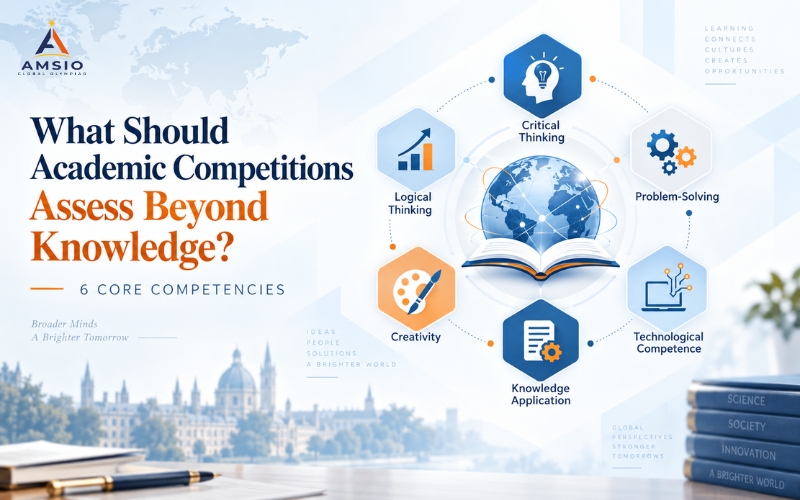
Critical Thinking: Can Students Evaluate Information?
Critical Thinking is about analyzing a problem carefully, examining evidence, and deciding which conclusion is better supported. For example: “Two students give different explanations for why a plant grew faster under one condition. Which explanation is better supported by the experimental data, and why?” The student cannot answer this question by recalling a single fact. They need to compare the two explanations, look at the available evidence, and justify their conclusion. In this case, the task is assessing both scientific understanding and the ability to evaluate information.
Logical Thinking: Can Students Recognize Relationships?
Logical Thinking focuses on structured reasoning, identifying patterns, and drawing conclusions from the information provided. A Mathematics or Computational Intelligence question might ask: “A sequence follows a hidden rule. After examining the first five values, which number should come next, and what rule explains your answer?” Finding the next value is only part of the task. Students also need to identify the relationship behind the sequence and explain why their answer makes sense. This helps show whether they reached the result through reasoning rather than guesswork.
Problem-Solving: Can Students Handle an Unfamiliar Challenge?
Problem-Solving becomes especially visible when students face a situation where the method is not immediately obvious. Consider this example: “A school needs to divide 120 students into activity groups under several conditions. What grouping strategy satisfies all of the requirements while using the fewest groups?” Students may already know the mathematical concepts involved, but they still need to decide how to use them. They have to understand the conditions, choose a strategy, test it, and adjust their approach if necessary. The challenge lies not only in knowing the mathematics, but in deciding what to do with it.
Creativity: Can Students Explore Different Solutions?
Creativity in an academic setting is not limited to art or design. It can also mean finding different ways to approach a problem and considering which solution works best. For example: “Design two different methods for reducing water use in a school. Which method would you choose, and what evidence would support your choice?” There may be several reasonable answers. Students need to generate ideas, compare their advantages and limitations, and explain why one option may be more suitable than another. This allows creativity to work together with reasoning rather than being treated as a completely separate skill.
Knowledge Application: Can Students Use What They Have Learned?
Remembering a concept and knowing when to use it are two different things. Knowledge Application focuses on whether students can transfer what they have learned into another context. A practical example could be: “A shop offers two discount plans. Using percentages, determine which plan gives the lower final price for a given purchase.” The percentage calculation itself may already be familiar. The real task is recognizing which mathematical idea is relevant and applying it correctly to a real situation. This shows whether knowledge can move beyond the textbook and become useful in practice.
Technological Competence: Can Students Think With Technology?
Technological Competence includes computational thinking, digital tools, and emerging technologies. Within AMSIO, this is particularly visible in Computational Intelligence, which covers areas such as Algorithmic Thinking, Computer Science, Artificial Intelligence, Programming, Data Science, and No-code/Low-code Development. An example might be: “A simple program sorts numbers incorrectly in one situation. Which step in the algorithm causes the error, and how should it be changed?” The aim is not simply to remember programming syntax. Students need to follow the logic of the process, locate the error, and suggest a correction. Similar skills can also be applied to data, such as interpreting a chart, identifying an unusual pattern, or deciding whether the available information is sufficient to support a conclusion.
From Correct Answers to Evidence of Thinking
Correct answers still matter, but they do not always tell the whole story. A well-designed academic question can require students to use subject knowledge while also showing how they reason, interpret, and apply it. This broader approach can be seen across AMSIO’s four subject areas. Mathematics includes mathematical reasoning, Science combines theory with applied concepts, Language develops from vocabulary and grammar toward Critical Reading and Inference, while Computational Intelligence introduces algorithmic thinking, programming, AI, and data-related skills. For schools, educators, and families, this creates a more complete way to look at student performance. The focus is not only on what students have learned, but also on how they use that knowledge when they encounter a new problem.
Conclusion
A meaningful international student competency assessment should go beyond measuring how much information a student can recall. Critical Thinking, Logical Thinking, Problem-Solving, Creativity, Knowledge Application, and Technological Competence each reveal a different part of the way students approach learning and academic challenges. Within the AMSIO framework, these six competencies support a broader view of assessment in which knowledge remains important, but students are also encouraged to analyze, reason, apply, and adapt what they know.