.png)
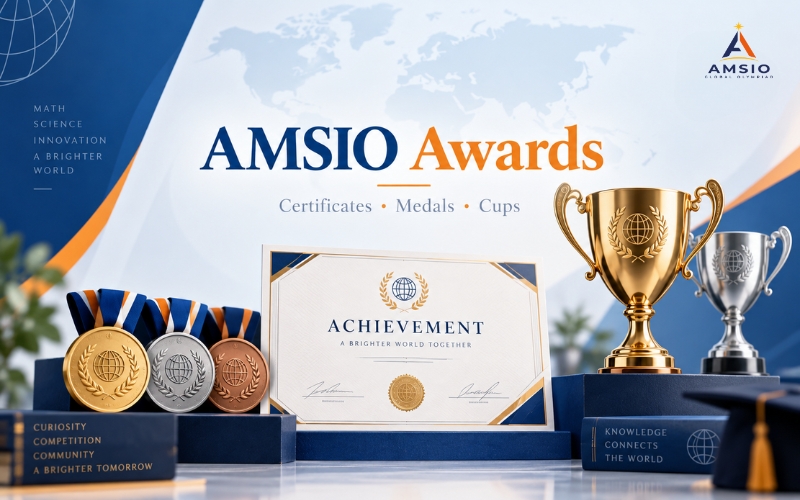
How Does the AMSIO Awards System Work? AMSIO has three competition stages: State Round, National Round and International Final Round. As students move through the competition, both the level of challenge and the form of recognition change. That distinction is important. AMSIO does not treat every stage of the competition in the same way. Certificates, medals, and special trophies are awarded at different points in the journey, so each form of recognition reflects a different level of achievement. As students progress through the competition, the awards also become more significant.
Round 1 – State Round The State Round is the first stage of AMSIO and is open to all registered participants. Strong performers may qualify for the National Round. At this stage, students are recognized through achievement certificates rather than physical medals. Gold Certificate: Top 10% Silver Certificate: Next 20% Bronze Certificate: Next 30% Certificate of Participation: For registered participants A Gold Certificate at the State Round is therefore different from a Gold Medal at the National Round or International Final Round. It recognizes strong performance at the first stage of the competition. For parents, this is an important point to understand: Gold, Silver and Bronze in Round 1 refer to achievement bands on certificates, not physical medals.
Round 2 – National Round Students who qualify from the State Round can move on to the National Round. For the 2026–2027 competition cycle, the top 60% of State Round participants are eligible to advance, while top performers at the National Round may be nominated for the International Final Round. This is also the stage where AMSIO begins awarding physical medals. The National Round awards include: Gold Medal: Top 6% Silver Medal: Next 12% Bronze Medal: Next 18% Certificate of Participation: For all Round 2 participants The National Round therefore marks a clear step forward in the AMSIO journey. Students are competing at a higher stage, and strong results are recognized with physical Gold, Silver or Bronze medals.
International Final Round The International Final Round is the highest stage of the AMSIO competition. For the 2026–2027 cycle, nominated students from the National Round are expected to take part in the final round in the United States. Participants compete within the Premier Division or Scholars Division. Awards at this stage include: Gold Medal: Top 10% Silver Medal: Next 20% Bronze Medal: Next 30% International Certificate: For all International Final Round participants Reaching the International Final Round is about more than the medal itself. Students have already progressed through earlier competition stages and now have the opportunity to compete alongside participants from other countries. The final round also includes activities such as cultural exchange, a STEM Workshop, campus and city tours, and the Gala Awards Ceremony. This makes the experience broader than a single exam day.
AMSIO Awards by Competition Round The table below gives parents and students a quick overview of how recognition changes from one round to the next. Competition Round Achievement Form of Recognition State Round
Gold Gold Achievement Certificate Silver Silver Achievement Certificate Bronze Bronze Achievement Certificate Participation Certificate of Participation National Round
Gold Physical Gold Medal Silver Physical Silver Medal Bronze Physical Bronze Medal Participation Certificate of Participation International Final Round
Gold Gold Medal Silver Silver Medal Bronze Bronze Medal Participation International Certificate Special Recognition Exceptional individual or team achievement Excellence Cup, Champion Cup or National Team Cup
The difference can be understood quite simply: Round 1 recognizes achievement through certificates, Round 2 introduces physical medals, and the International Final Round brings international-level recognition together with medals and special trophies.
What Are the Special AMSIO Cups? Alongside certificates and medals, AMSIO has three special trophies: the Excellence Cup, Champion Cup and National Team Cup. These cups are not simply higher versions of Gold, Silver or Bronze. Each one recognizes a different kind of achievement.
- Excellence Cup The Excellence Cup is awarded to students who achieve Gold Medals in two or more subjects at the International Final Round. For example, a student who earns Gold in both Mathematics and Science may meet the requirement for the Excellence Cup. The award highlights students who can perform strongly across different academic areas rather than in only one subject.
- Champion Cup The Champion Cup recognizes long-term achievement. To qualify, a student must achieve a Gold Medal in three consecutive AMSIO competition years. Unlike an award based on one competition result, the Champion Cup reflects consistency. A student must maintain a high level of performance across several AMSIO seasons, making it a recognition of both achievement and continued effort.
- National Team Cup The National Team Cup is a team award rather than an individual one. It is presented to the country with the most outstanding achievements at the International Final Round. The award recognizes the combined performance of the national delegation, including its students, schools and educators. While students compete individually in AMSIO, their results can therefore also contribute to the overall achievement of their national team.
Conclusion The AMSIO awards system follows the student’s progress through each stage of the competition. At the State Round, students can earn Gold, Silver and Bronze Achievement Certificates. At the National Round, top performers can receive physical medals. Those who continue to the International Final Round compete for international medals and certificates, while the Excellence Cup, Champion Cup and National Team Cup recognize achievements beyond a single subject or competition result. Understanding this structure helps parents clearly see what each certificate, medal, and trophy represents. More importantly, AMSIO awards reflect how far a student progresses and how well they perform at each stage, rather than being given simply for taking part. This makes every form of recognition more meaningful and helps students see their achievements as part of a wider learning and competition journey.