
5 Steps to Prepare for the AMSIO Local Round
A good preparation plan does not need to be complicated. Students can focus on five key steps to become more comfortable with the competition and make the most of their preparation time.
- Confirm Your Subject and Exam Level
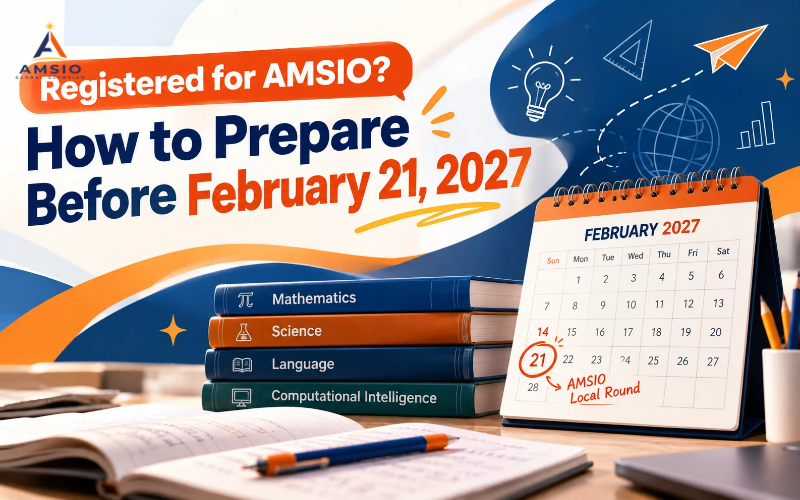
Before studying, students should double-check their registered subject and grade level. AMSIO offers four subjects: Mathematics, Science, Language, and Computational Intelligence (CI). Each subject has its own knowledge areas, grade requirements, and assessment structure. Students should also confirm their exam level, especially if they have registered for a level above their current grade. Tip: Make sure your selected subject and level match your registration details before creating a study plan.
- Understand the Exam Structure
Knowing what to expect can make preparation more effective. Each AMSIO subject has its own question count, time limit, and assessment format. According to the AMSIO 2026–2027 Handbook: Mathematics: 25 questions for Grades 1–5 and 30 questions for Grades 6–12, with a 90-minute time limit. Science: 25 questions in 60 minutes across six exam levels. Language: 50 questions at the basic levels or 60 questions at the advanced levels, with a 90-minute time limit. Computational Intelligence: 30 questions across three levels, with a 60-minute time limit for Level 1 and 90 minutes for Levels 2 and 3. The assessment includes multiple-choice and logical reasoning questions. Students should review the structure of their selected exam and practise accordingly. Tip: Check the official AMSIO guidelines for your registered level before choosing practice materials.
- Strengthen Your Basic Knowledge
Before attempting difficult questions, students should review the fundamental concepts of their chosen subject. For Mathematics, this may include algebra, geometry, number patterns, and mathematical reasoning. Science preparation can focus on important concepts in Physics, Chemistry, Biology, and Earth Sciences. Language students can practise reading comprehension, vocabulary, grammar, and inference, while CI students can review logical thinking, algorithms, and foundational computational concepts. Rather than trying to memorise everything, students should focus on understanding how ideas work and how they can be applied in different situations. Tip: Try explaining a concept in your own words. If you can explain it clearly and apply it to a new example, you are developing a stronger understanding.
- Practise New Problems and Explain Your Reasoning
AMSIO preparation should go beyond memorising answers or repeating familiar practice questions. Students can practise unfamiliar problems and reflect on the steps they take to reach a solution. For example, after solving a Mathematics problem, ask yourself: "Why does this method work? Could I solve it another way?" In Science, students can practise explaining observations using evidence. In Language, they can explain why a particular answer is supported by a passage. For CI, they can practise recognising patterns and applying logical reasoning to new situations. The goal is to develop flexible thinking rather than expect the competition to repeat familiar practice questions. Tip: Focus on understanding the reasoning behind an answer, not simply whether the answer is correct.
- Improve Reading, Time Management, and Error Analysis
Good preparation also involves developing useful exam habits. Students should practise reading instructions carefully, identifying important information, and managing their time across different questions. After completing a practice session, review mistakes instead of simply checking the final score. Ask yourself: Did I misunderstand the question? Was I missing important knowledge? Did I spend too much time on one problem? What could I do differently next time? Understanding mistakes helps students identify areas that need more practice and avoid repeating the same errors. Tip: Keep a simple record of common mistakes and revisit them regularly. Small improvements over time can make preparation more effective.
How Can Parents Support AMSIO Preparation?
Parents can play an important role in helping students prepare by encouraging curiosity, supporting independent learning, and maintaining a balanced study routine. Instead of focusing only on scores or how many questions their child has completed, try asking: What did you learn today? Which question made you think the most? How did you solve that problem? What would you like to practise next? These conversations encourage students to reflect on their learning and become more confident in their abilities. Parents can also help create a realistic study schedule that includes time for rest, schoolwork, and other activities. With the Local Round scheduled for February 21, 2027, students can use the preparation period to make steady progress rather than rushing through large amounts of material. The goal is not to create pressure for a particular result, but to help students approach an academic challenge with curiosity, confidence, and a willingness to learn.
Conclusion
Preparing for AMSIO does not have to mean endless practice tests or long study sessions. By following these five steps, students can strengthen their knowledge, develop problem-solving skills, and build better exam habits. What matters most is understanding what they know, recognising areas for improvement, and becoming more confident when approaching unfamiliar academic challenges. Getting ready for the AMSIO Local Round on February 21, 2027? Save this five-step preparation guide and use it to organise your study plan. Remember to check your registration details, exam format, and the latest official announcements from your school or local AMSIO organiser before competition day.