Who Can Register for the AMSIO 2026 State Round?
Parents often wonder if their children need to attend an international school or have previous Olympiad experience to join AMSIO. The good news is that neither is required. AMSIO welcomes students from public schools, private schools, international schools, and homeschooling backgrounds. Students studying abroad or following different educational programs can also participate, provided they meet the relevant eligibility and registration requirements. Mathematics, Science, and Language are available for students from Grades 1–12, while Computational Intelligence welcomes students in Grades 3–12+ and other eligible advanced learners. Students from any country can join the first round, even if they have never won an academic award before. For students joining AMSIO for the first time, the State Round offers a great opportunity to experience an international academic competition and discover their potential. Some students may join because they enjoy solving challenging problems, while others may want to try something outside their usual school activities. Whatever their motivation, choosing a suitable subject and understanding the competition level can help them begin with realistic expectations.
What Subjects Are Available for AMSIO 2026?
Students can register for one or more of the four AMSIO competition subjects. Each subject focuses on different areas of knowledge and reasoning, allowing participants to explore the topics that interest them most. Before enrolling, families should review what each subject covers and consider which option best matches the student's current abilities and learning goals.
Mathematics: Explore Numbers and Logical Thinking
Mathematics is open to students from Grades 1–12, with separate examination levels for each grade. The subject covers number relationships, algebra, geometry, probability, and mathematical reasoning. Students may encounter questions that require them to identify patterns, analyze information, or approach familiar concepts in unfamiliar ways. It is a good fit for students who enjoy solving puzzles, exploring numbers, and discovering different approaches to a problem.
Science: Discover How the World Works
Science covers Physics, Chemistry, Biology, and Earth Science, with assessments organized into six grade bands from Grades 1–12. Questions encourage students to use scientific knowledge to understand natural phenomena and everyday situations. Students who enjoy observing the world, asking questions, and exploring why things happen may find this subject particularly interesting. The goal is to help students understand scientific concepts and use what they learn to solve problems, rather than just memorize definitions.
Language: Strengthen Reading and Understanding
Language is designed for students from Grades 1–12 and focuses on reading comprehension, vocabulary, grammar, and the ability to understand and interpret written information. The competition framework includes English and other international languages, subject to the options available in each region. Students may need to identify main ideas, understand meaning from context, or draw conclusions from a passage. This subject is a great choice for students who love reading, exploring language, and understanding how words express different ideas.
Computational Intelligence: Discover Technology and Problem-Solving
Computational Intelligence is available for students from Grade 3 through Grade 12+ and includes three competition levels. It introduces topics such as logical reasoning, algorithmic thinking, computer science, artificial intelligence, programming, and data science. Younger participants begin with logical and computational reasoning, while higher levels include more advanced tasks. Students who are curious about computers, enjoy coding, or want to discover how technology works may find this subject especially interesting.
Before You Register: Three Important Things to Check
Before starting the application, parents should take a few minutes to review the information needed for enrollment. Checking these details early can reduce confusion and help ensure that the selected subject and competition level are appropriate for the student.
Choose the Subject and Number of Entries
The first decision is choosing which subject your child wants to enter. AMSIO allows students to register for multiple subjects, but participating in several is not a requirement. For students joining an Olympiad for the first time, focusing on one subject may provide enough opportunities to learn about the competition format and practise unfamiliar questions. Students who enjoy several academic areas may choose additional subjects if they have enough time to prepare. Parents should also review the applicable registration fees before confirming their choices. Under the official AMSIO framework, fees are calculated per student and per subject, so the total cost may depend on the number of subjects selected and the arrangements in the relevant region.
Check the Correct Grade and Competition Level
AMSIO uses different level structures for each subject, making it important to check the official requirements before registering. Mathematics has 12 individual grade levels, while Science and Language use six grade bands. Computational Intelligence has three levels covering Grades 3–5, 6–9, and 10–12+. The competition also allows students to register for an examination level above their current school grade. However, moving to a higher level should be based on the student's readiness and understanding of the subject. Parents should review the available level information and avoid choosing a more advanced examination simply because it appears more challenging.
Review Student and School Information
Parents should prepare their child's full name, current grade, school information, and relevant contact details before completing the registration form. These details should be entered accurately and checked against the requirements provided by the official system. If the student is registering through a participating school, families should also confirm whether a School Code is required. Having the correct information ready can make the registration process more straightforward and reduce the need to correct mistakes after submission.
How to Register for the AMSIO 2026 State Round
AMSIO supports registration through participating schools and educational institutions, as well as individual registration through the official system. The appropriate method depends on the student's circumstances and the procedures used in their country or region.
Option 1: Register Through Your School
Students whose schools participate in AMSIO can follow the enrollment instructions provided by their school coordinator. Under the official registration framework, a school contacts AMSIO International or its designated National Partner, completes the institutional registration requirements, and receives a unique School Code. Students can then use the code as instructed to complete their registration. Parents should check with the school coordinator to confirm which information is required, whether the school is managing student enrollment, and how the applicable registration fee should be paid. If your child's school has not yet shared AMSIO registration information, you can ask whether it is participating in the competition or contact an authorized AMSIO representative for guidance. School registration arrangements may differ between countries, so it is important to follow the procedure that applies locally.
Option 2: Register Individually Through AMSIO
Students who are not registering through a participating school can follow the individual registration instructions provided through the official AMSIO system. The AMSIO Handbook also recognizes individual enrollment arrangements for homeschooled students, including the use of an appropriate school code where required. Start by visiting the official AMSIO website and checking the registration details for your country or region. Take time to explore the available subjects and competition levels, gather the necessary student information, and follow the steps provided in the registration system. Before completing your registration or making a payment, double-check your chosen subject, exam level, and personal details. It's also important to review the registration fees, exam arrangements, and confirmation instructions to make sure everything is in order. For official enrollment information, visit www.amsio.org.
What Happens After AMSIO Registration?
After completing registration, the next step is preparing for the State Round. Students can begin by reviewing the content areas for their chosen subject and becoming familiar with the examination format. AMSIO provides information about competition subjects, grade levels, and preparation resources through its official channels, which can help families understand what to expect. Preparing for AMSIO doesn’t have to involve hours of memorization or completing practice papers every day. For Mathematics, students can focus on understanding key concepts and explaining how they arrive at their answers. In Science, connecting classroom lessons to real-life situations can make learning more meaningful. For Language and Computational Intelligence, students can build their skills through reading, reasoning, and practising logical thinking. Parents can support their children by helping them build a manageable study routine alongside their regular schoolwork. Short, focused practice sessions and time to review mistakes may be more useful than rushing through large numbers of questions. Students should also pay attention to any examination instructions provided by their school or the relevant organizing body.
Where Can Parents Find Official AMSIO Registration Information?
The best place to start is the official AMSIO International website, where students, parents, and schools can explore the competition structure, available subjects, and registration information. Families registering through a school should follow instructions from their school coordinator or authorized National Partner. Individual participants should use the official AMSIO registration system and make sure they are following the process that applies to their region. Because registration deadlines, examination locations, and local procedures may vary, parents should rely on current official announcements rather than information from previous competition years. If anything is unclear, contacting the appropriate AMSIO representative before submitting an application is a sensible next step.
Conclusion
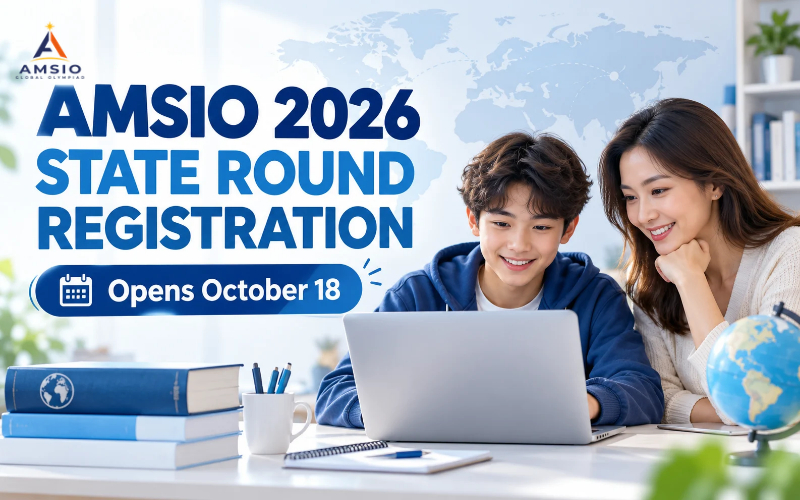
The AMSIO 2026 State Round registration, scheduled to open on October 18, offers students a chance to explore international academic challenges in Mathematics, Science, Language, and Computational Intelligence. Before registering, families should choose a suitable subject, check the correct competition level, and prepare the required information for a smooth start.