.png)
Why AMSIO Preparation Should Go Beyond Practice Papers
Practice papers still have a useful role. They can help students understand the format of the exam, become familiar with the types of questions they may encounter, and practise working within a time limit. However, preparation becomes less useful when students simply complete one paper after another without reviewing how they approached each problem.
AMSIO includes Mathematics, Science, Language, and Computational Intelligence. Across these subjects, students may need to work with mathematical reasoning, applied scientific concepts, Critical Reading and Inference, as well as algorithmic and computational thinking. For that reason, preparation should focus not only on whether students know the content, but also on whether they can use it when the context or question format changes.
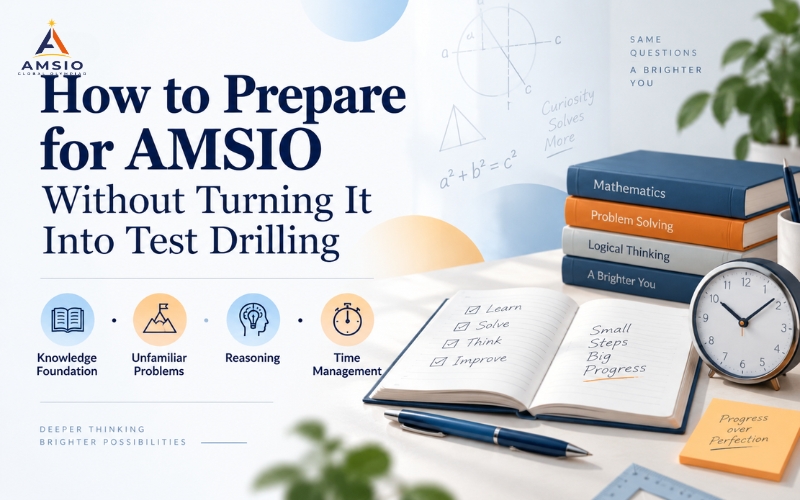
- Build a Strong Knowledge Foundation
Start with the foundations. Before attempting more difficult questions, students should make sure they understand the core knowledge for their subject and level. Focus on the relevant topics: Mathematics: Number relationships, algebra, geometry, probability, and mathematical reasoning. Science: Physics, Chemistry, Biology, and Earth Sciences. Language: Reading, Vocabulary, Grammar, Critical Reading, and Inference. Computational Intelligence: Algorithmic Thinking, Computer Science, AI, Programming, and Data Science. Check for understanding. Ask: “Can I explain this idea in my own words and use it in a different situation?” If the answer is yes, the student is beginning to understand the idea rather than simply memorising a rule.
- Work With Unfamiliar Problems
Once the basics are secure, students should gradually practise questions that look different from the examples they already know. For example, after learning how percentages work, instead of solving several nearly identical calculations, students could compare two real-life offers and decide which one provides better value. In Science, rather than simply recalling a definition, they could look at observations from an experiment and decide which explanation is best supported by the evidence. The purpose is not to make every question more difficult. It is to help students become comfortable when the solution is not immediately obvious. They learn to identify what information matters, connect it with what they already know, and decide which approach to try.
- Practise Explaining the Reasoning
A correct answer is useful, but students can learn even more by explaining how they arrived at it. After completing a problem, they can ask themselves questions such as: “Why did I choose this method?”, “Which information was important?”, “Could I solve it another way?”, or “How can I check my answer?” This habit can reveal problems that the final answer alone does not show. A student may reach the correct answer by guessing, while another may understand the method correctly but make a small calculation error. Looking at the reasoning makes it easier to see what actually needs improvement. It also encourages students to focus less on memorising a fixed solution and more on understanding why a particular approach works.
- Improve Question Reading and Time Management
Students also need to know how to use their knowledge effectively under exam conditions. That begins with reading the question carefully. Simple habits can make a difference: read the full question before starting, identify key conditions, determine exactly what needs to be found, and check whether the final answer actually addresses the question. Time management should also be practised gradually. AMSIO exam durations vary by subject and level, so students need to understand their own working pace. If one problem is taking too long, it may be better to move on and return to it later rather than spending too much time in one place. The goal is not to work as fast as possible. It is to use the available time calmly and deliberately.
How Should Students Use Sample Papers?
Sample papers are most useful when they are treated as a learning tool rather than a score-chasing exercise. After completing a practice set, students should review not only which questions were wrong, but also why they were difficult. Was the concept unclear? Did they misunderstand the question? Was the problem unfamiliar? Did they choose the wrong strategy, or simply spend too much time on one part? This kind of review gives each practice paper a clear purpose. Instead of immediately moving on to the next set of questions, students can use what they learned to decide what to work on next.
Conclusion
To prepare for AMSIO, students need more than a stack of sample papers. They can strengthen their subject knowledge, try problems they have not seen before, practise explaining their answers, and get used to reading carefully under time pressure. Sample papers are useful for seeing how these skills come together. They also help students notice where they are confident and where they need more practice before facing a new academic challenge.