.png)
Does Computational Intelligence Require Coding Experience?
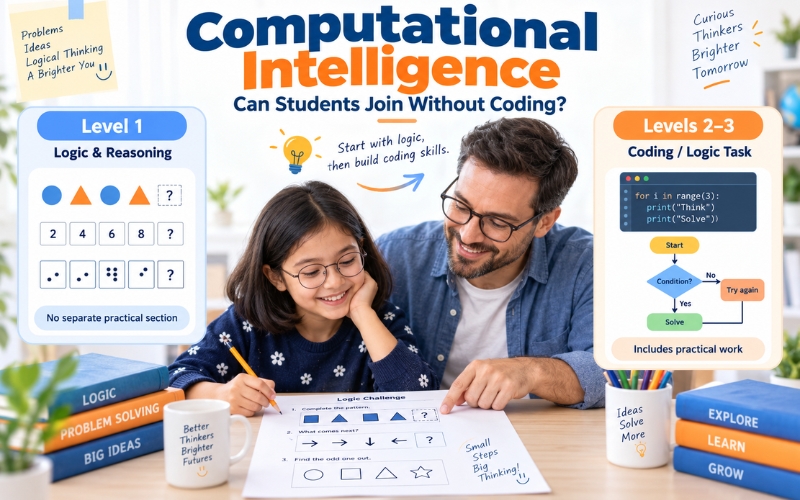
Not from the beginning. Programming is part of Computational Intelligence, but the subject is broader than coding alone. It also covers algorithmic thinking, computer science, AI, data science, and no-code/low-code development. What connects these areas is the way students approach a problem. Before writing any code, they first need to understand what the task is asking, identify useful information, decide what should happen first, and build a clear sequence of steps. Coding is then one way to turn that thinking into a solution. This is why AMSIO divides Computational Intelligence into three levels. Level 1 is designed for Grades 3–5, Level 2 for Grades 6–9, and Level 3 for Grades 10–12+. The expectations increase as students move up, so a Grade 3 student is not expected to have the same programming experience as a Grade 10 student.
Level Grades Exam Structure Main Focus What Students Develop Level 1: Building Logic Before Learning to Code Grades 3–5 30 questions / 60 minutes | MCQ & Logical Reasoning | No separate practical section At this stage, students focus on logic, patterns, sequences, and structured reasoning rather than writing programs. They may identify what comes next in a sequence, discover the rule behind a pattern, arrange actions in the correct order, or choose the most logical solution. Students build the thinking behind coding first. They learn how to break a problem into smaller steps and organize those steps logically, creating a foundation for algorithms and programming later. Level 2: From Logical Thinking to Practical Tasks Grades 6–9 30 questions / 90 minutes | 120-minute practical section | MCQ + Coding/Logic Task Students begin connecting logical and algorithmic thinking with practical tasks. Coding becomes more relevant, but understanding the problem and planning the solution remain essential. Students learn to analyze a task, divide it into manageable steps, choose an approach, and gradually express their ideas through code or structured logic tasks. Preparation should develop both reasoning and practical skills together. Level 3: Coding Matters More, but It Still Starts With Reasoning Grades 10–12+ 30 questions / 90 minutes | 120-minute practical section | MCQ + Coding/Logic Task Students work with more advanced areas of Computational Intelligence, including algorithms, computer science, AI, programming, and data science. Programming becomes increasingly important, but students still need to understand the problem before writing the solution. The key is not only “Can the student code?” but also “Can the student work out what the code needs to do?”
What Should Beginners Practice First?
Students who are completely new to the subject do not need to begin with a difficult programming language or a large coding project. A better starting point is to practise the thinking skills that support coding. This can include recognizing patterns, putting instructions in the correct order, finding mistakes in a sequence, dividing a large problem into smaller parts, comparing different solutions, and explaining why one approach works better than another. Students can also begin working with simple data. Looking at a table, graph, or set of numbers and asking what the information shows is already a useful introduction to data reasoning. These activities make the transition to coding much easier. Instead of memorizing commands without understanding them, students learn what problem they are trying to solve first. Programming then becomes a tool for carrying out that solution.
Can a Student Join Without Knowing How to Code?
Yes, especially at Level 1. For Grades 3–5, there is no separate practical coding section. The format focuses on multiple-choice questions and Logical Reasoning, so students can begin by developing logic and structured problem-solving. From Level 2 onward, students should be ready to work more directly with coding or practical logic because the assessment introduces a Coding/Logic Task. The progression is gradual: students first build the way of thinking, then learn how to apply that thinking through more practical tasks. This means Computational Intelligence should not be seen as a subject only for students who already know programming. A child who enjoys puzzles, patterns, step-by-step problem-solving, technology, or working with data already has a useful starting point.
Conclusion
So, does Computational Intelligence require programming knowledge? It depends on the level. At Level 1, students do not have a separate practical coding section, with the assessment focusing mainly on Logical Reasoning. At Levels 2 and 3, Coding/Logic Tasks are introduced, making programming and practical problem-solving increasingly important. However, the foundation remains the same at every level: students need to understand the problem, recognize patterns, break a task into smaller steps, and build a logical solution. For beginners, the first question does not have to be, “Which programming language should they learn?” A more useful question is: “Can they solve a problem one clear step at a time?” That is where Computational Intelligence begins.