.png)
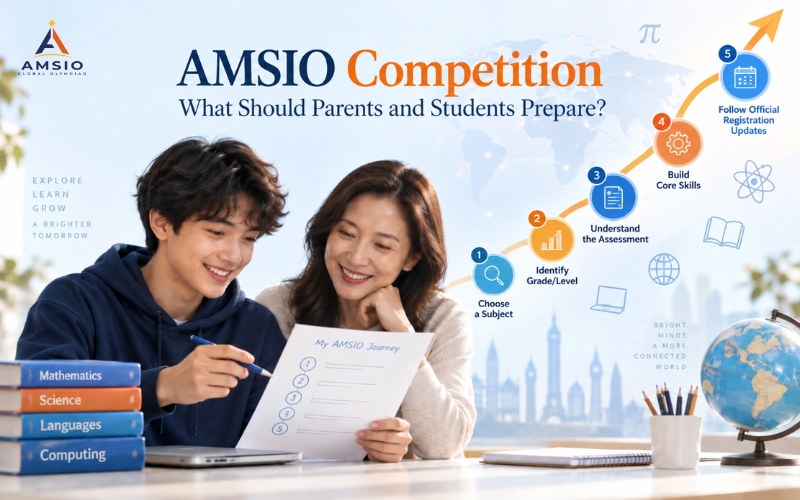
Before Joining the AMSIO Competition, Where Should Students Start? It can be tempting to begin with practice papers as soon as a student becomes interested in AMSIO. But that is not always the best first step. AMSIO is designed for students across different grades, subjects, and skill levels. The competition covers four subjects and follows a three-round structure, moving from the State Round to the National Round and then the International Final Round. Because of that, preparation should begin with understanding the competition itself. A simple roadmap is: Choose a subject → Find the right grade or level → Understand the assessment → Build the right skills → Follow official registration updates.
Step 1: Choose the Subject That Fits the Student AMSIO offers four subjects: Mathematics, Science, Language, and Computational Intelligence. Students may register for one or more subjects. The best choice should not depend only on school grades. A student may score well in several subjects but feel much more interested in one type of problem. For students who enjoy numbers, patterns, geometry, probability, and logical challenges, Mathematics may be a good choice. The subject covers areas such as number theory, algebra, geometry, probability, and mathematical reasoning. Students who often ask “why?” and enjoy learning how things work may feel more comfortable with Science. AMSIO Science includes Physics, Chemistry, Biology, and Earth Sciences, with both theoretical and applied concepts. For students who enjoy reading, working with words, understanding meaning, and making inferences, Language may be the better fit. The assessment includes Reading, Vocabulary, Grammar, Critical Reading, and Inference. Computational Intelligence, available from Grade 3, focuses on areas such as algorithmic thinking, computer science, AI, programming, data science, and no-code or low-code development. Instead of asking only, “Which subject is my child best at?”, parents can also ask: “What kind of thinking does my child enjoy?”
Step 2: Find the Right Grade or Level Once the subject is clear, the next step is to understand where the student fits in the AMSIO structure. The subjects do not all use the same level system. Mathematics has 12 individual grade levels, with each grade taking its own paper. Science and Language are divided into six grade-band levels. Computational Intelligence has three levels, covering Grades 3–5, Grades 6–9, and Grades 10–12+. This matters because students at different levels may face different question types, time limits, and expectations. AMSIO also allows students to register at a higher exam level than their current grade. However, choosing a higher level should be based on the student’s actual ability and readiness, not simply on the idea that a harder paper is always better. The goal is to find a level that gives the student a meaningful challenge without making the experience unnecessarily difficult.
Step 3: Understand How Each Subject Is Assessed Two students may both join the AMSIO competition but have very different test experiences depending on their subject and level.
Subject Level / Grades Questions Theory Time Practical Time Format / Focus Mathematics Grades 1–5 25 60 min — MCQ / Short Answer Mathematics Grades 6–12 30 90 min — MCQ / Short Answer Science Grades 1–12 25 60 min — MCQ / Short Answer Language Grades 1–8 50 60 min — MCQ / Vocabulary / Grammar Language Grades 9–12 60 90 min — MCQ / Critical Reading Computational Intelligence Level 1: Grades 3–5 30 60 min — MCQ / Logical Reasoning Computational Intelligence Level 2: Grades 6–9 30 90 min 120 min MCQ + Coding / Logic Task Computational Intelligence Level 3: Grades 10–12+ 30 90 min 120 min MCQ + Coding / Logic Task
The assessment structure varies by subject and level, so understanding the format in advance can help students prepare more effectively for the type of questions, time limits, and skills required.
Step 4: Build the Skills Before Focusing on Practice Tests Practice papers can be useful, but they should not be the whole preparation plan. AMSIO highlights six core competencies: Critical Thinking, Logical Thinking, Problem-Solving, Creativity, Knowledge Application, and Technological Competence. These skills can be developed in simple ways. For Mathematics, students can practise spotting patterns, breaking a problem into smaller steps, and explaining why an answer makes sense. For Science, they can build the habit of observing, asking questions, comparing evidence, and connecting what they learn with real situations. For Language, reading regularly is important, but students should also practise finding the main idea, understanding words in context, and making conclusions from information that is not stated directly. For Computational Intelligence, students can work on logical sequences, step-by-step problem solving, basic algorithmic thinking, and data reasoning before moving into more advanced programming tasks. The point is not to memorize as many question types as possible. It is to become more comfortable with unfamiliar problems and learn how to work through them.
Step 5: Follow Official AMSIO Information Once the student has chosen a subject and started preparing, families should keep an eye on official AMSIO updates. Schools and educational institutions can register through AMSIO International or a National Partner where available. Schools receive a School Code that students can use during enrollment. Individual students can also register through the AMSIO online registration system. Families should also remember that some details may vary by country or region. The State Round and National Round may be held either on paper or online, depending on arrangements made by the National Partner. That means dates, test locations, local procedures, and participation instructions should always be checked through official AMSIO channels rather than relying only on information from previous years.
Conclusion Preparing for the AMSIO competition does not have to begin with hours of practice tests. A better starting point is to answer five simple questions: Which subject fits the student? Which grade or level should they enter? What will the assessment look like? Which skills should they build? And where can the family find official participation information? Once these questions are clear, preparation becomes much easier to plan. Students can focus on the right skills, while parents can support them without turning the competition into unnecessary pressure. AMSIO 2026–2027 is a chance for students to challenge themselves across Mathematics, Science, Language, and Computational Intelligence while developing broader skills such as reasoning, problem-solving, and applying knowledge in new situations. The best preparation is not simply starting early. It is starting in the right direction.