Overview of the 4 AMSIO Subjects
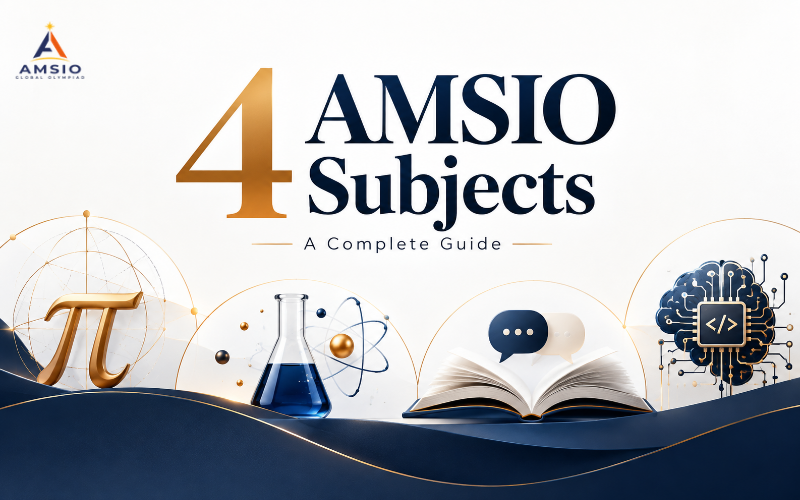
The AMSIO International Olympiad offers four competition subjects for students across different grade levels.
Subject Grade Main Knowledge Areas Mathematics Grades 1–12 Number theory, algebra, geometry, probability, and mathematical reasoning Science Grades 1–12 Physics, chemistry, biology, and Earth sciences Language Grades 1–12 Reading comprehension, vocabulary, grammar, critical reading, and inference Computational Intelligence (CI) Grades 3–12+ Algorithmic thinking, artificial intelligence (AI), programming, and data science
Students can register for one or more subjects based on their interests, abilities, and academic readiness.
What Does Each AMSIO Subject Focus On?
Each subject encourages students to use their knowledge in different ways. Understanding these differences can help students make a more suitable choice.
- Mathematics – Think Logically and Solve Problems
Mathematics focuses on logical thinking, recognizing patterns, and finding solutions. For example, students might need to identify a number pattern, compare different solutions, or apply geometry to an unfamiliar situation. It’s not just about memorising formulas. Students should understand the ideas behind them and be able to recognise when and how to apply them to different problems. Best suited for: Students who enjoy numbers, puzzles, logical reasoning, and problem-solving.
- Science – Understand How the World Works
Science encourages students to explore natural phenomena and apply scientific knowledge. For example, a question might ask students to explain explore why plants grow better in some conditions than others or make predictions about what might happen in a simple experiment. Students need to connect scientific concepts with observations and evidence instead of simply repeating facts they’ve memorised. Best suited for: Students who are curious about nature, experiments, and understanding how things work.
- Language – Read, Understand, and Make Connections
Language focuses on reading comprehension, vocabulary, grammar, and the ability to understand meaning from context. For example, students might read a short passage, identify the writer's main idea, or use clues to understand an unfamiliar word. Students learn to read carefully, think about what a text means, and look beyond simply knowing words and grammar rules. Best suited for: Students who enjoy reading, exploring languages, and understanding different ideas.
- Computational Intelligence
Computational Intelligence (CI) introduces students to computational thinking, algorithms, AI, programming, and data. For example, students might see how step-by-step instructions can solve a problem, spot mistakes in a sequence of steps, or find patterns in information. The focus is on understanding how problems can be broken into smaller steps and solved systematically. Best suited for: Students interested in technology, coding, AI, and logical challenges.
How Can Students Choose the Right AMSIO Subject?
Choosing the right AMSIO subject involves considering personal interests, academic strengths, grade eligibility, and preparation time. Students can also try sample questions to explore different types of challenges and assess their readiness. However, these questions are intended for practice and should not be treated as a preview of the actual exam.
Conclusion
The 4 AMSIO subjects give students a chance to discover their strengths and build new skills. Whether they enjoy Mathematics, Science, Language, or Computational Intelligence, what matters most is choosing a subject they’re genuinely interested in, feel ready to explore, and want to keep learning about. Not sure which subject is right for you? Read our next guide, "How to Choose the Right AMSIO Subject", to explore the key factors to consider before registering.